There are highlights of some players who are described generally, and anonymously, in my new book Evolution of 180 Shooter: A 21st Century Guide, now available through Amazon.
Evolution of 180 Shooter: Drills
Below are some of the drills featured in my new book Evolution of 180 Shooter: A 21st Century Guide, now available through Amazon.
Evolution of 180 Shooter — Now Available!
.
“Brian McCormick’s philosophy is an absolute game changer for shooting development. Evolution of 180 Shooter provides easy to implement ideas to evolve skill development for players and coaches at all levels.”
— Kenny Atkinson, NBA Head Coach
In 2009, I published 180 Shooter, which described my teaching methodology and drill progressions as a private shooting coach in the prior decade. A few players set NCAA shooting records and became All-Americans, but others struggled, and I examined the cause. I attributed some of their failings to my coaching and workouts, and I quit private coaching.
Over the last decade, I worked with teams as a head coach and a consultant. I have coached very good shooters — one finished second nationally in 3-point shooting percentage and another set the college’s record for 3FGs — and very good shooting teams: 3rd in 3FG/G (9.7), 6th in 3FG% (37.4%), and 9th in FT% (72.6%).
Evolution of 180 Shooter: A 21st Century Guide chronicles the evolution of my thinking over the last decade and challenges the prevalent shooting dogma. My greatest changes have been to re-define game-like shots and appreciate the environment’s role in developing shooters. This is not a technique or drill book; it focuses on our culture of shooting — from our practice, to the extra shots, to the comfort and confidence — which develops shot makers.
“If you coach basketball at any level, read and study Brian McCormick’s writing: It will re-calibrate your view of the game. You will think differently about basketball and how to teach the game to others.”
— Lindell Singleton, Head Coach: The Game Matters AAU
Mythologizing practice reps
I responded to a tweet about Kobe Bryant’s advice to Tracy McGrady, and I honestly expected more pushback, but the comment below is the popular opinion.
5 NBA Championships, 18 time All Star, 2 time Olympic Gold Medalist and 33,643 career points
— X-ray Basketball (@XrayBasketball) June 11, 2020
The response lists his accomplishments, which were never debated. My comment pertained to practice. Kobe was one of the best players in NBA history, but that statement does not answer a question about specific improvements derived from practice.
Often, ex-players or prominent coaches and trainers obfuscate questions by answering a different question.
Q: How does that drill improve performance?
A: He’s one of the best players in the NBA.
Incredibly, many people accept these answers. We believe that practice improves performance, and the player is one of the best, which shows that the practice worked.
I see the non-answer as evidence that the player/coach/trainer don’t know. They invest in more work and hope for improvement.
We confuse correlation with causation. We know Kobe notoriously practiced more than anyone else. We also know Kobe was one of the best players in NBA history. Therefore, we argue Kobe was one of the best players BECAUSE he made 1000 shots per day, as we are biased to believe practice causes performance. Instead, these two things are correlated; they are related, but not necessarily causal.
Now, to answer my question, his practice fueled his confidence. Of course, some may view this as a blessing and a curse. He believed nobody practiced more or harder than he did. He knew he was the most prepared player for every game. He derived confidence from these beliefs.
This confidence likely led to some bad shot selection, which dampened his shooting percentages. I imagine he believed he earned the right to take questionable shots because he practiced more. He believed he could make any shot. This confidence separated him from his peers.
Would he have had the same confidence if he made 250 shots per day or if he took a day off? Would that change his confidence? Would he feel like he cheated the game? Nobody knows.
Would he have shot a lower percentage if he only made 250 shots per day or took a few days off? Unlikely. The evidence suggests he did not improve his shooting much, if at all, over a 20-year career during which he made 1000 shots every day in the offseason. What effect did all of those repetitions have on his shooting?
I believe we make this error of attribution frequently. We latch on to well-publicized stories of extreme work ethic, and mythologize this effort because we want to motivate our players to spend more time in the gym. NBA players working out at 4 AM are the same; if you work out for 2-3 hours per day, does it matter if it is at 4 AM or noon? We tell stories that turn correlation into causation, and nobody challenges the story because we have accepted the moral as true and believe it benefits players even if not entirely true.
Practicing at 4 AM or 6 AM is not better than practicing at noon or 5 PM, and there is evidence to suggest it is worse, especially for athletes who perform late in the afternoon/evening. Similarly, making 1000 shots per day is not necessarily better than making 500 shots or even 100 shots. It depends on the practice quality.
We don’t know if Kobe would have won championships and MVPs if he had practiced less. However, we know his percentages did not improve greatly, despite shooting more than virtually anyone in NBA history. If his practice was the reason he was an MVP and NBA Champion, why couldn’t he raise his free-throw shooting percentage above his career-high 86.8%? Field-goal percentage and three-point percentage can be explained by poor shot selection, but not free-throw percentage. He shot 81.9% as a rookie and 83.7% for his career. He only had five seasons over 85%. He likely attempted more practice shots than anyone in history, according to mythology, but never had a single season over 87% from the FT line. And, yet, we attribute all of his greatness to this practice.
What prevented him from reaching shooting excellence? He did not have a single season over 50% from the field, or 40% from the 3-point line, or 90% from the free-throw line. If not his practice, was it his mental toughness, another quality coaches/trainers use to explain a lack of performance during games? If Kobe has been mythologized for any attribute more than his practice and work ethic, it is his mental toughness.
Again, Kobe was a top 10 player in NBA history. He practiced, by all accounts, more than anyone in NBA history. Neither point is up for debate. However, the veracity of these points does not explain the relative lack of shooting improvement across his career.
Ultimately, for an individual, it does not matter. He invested time and energy, and he achieved his desired results. To some extent, whether or not the time and energy caused the results does not matter. However, we need to determine whether the training caused the specific improvements that we hope to achieve when we attempt to generalize the training to groups of players.
Thinking differently about baseline sprints
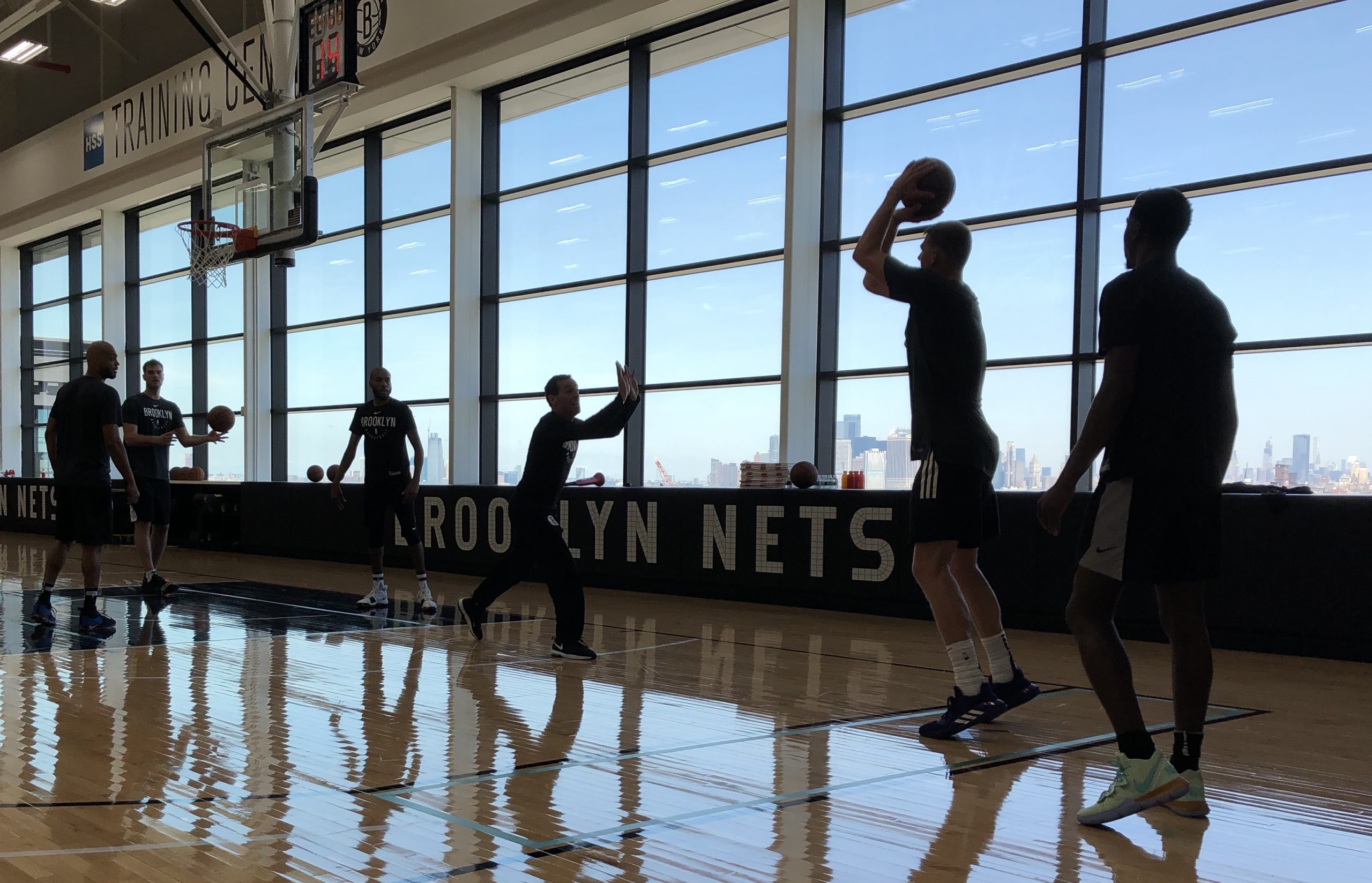
I attended a few days of optional workouts with an NBA team last fall. After one session, the players did a conditioning drill, running baseline to baseline. As I watched them run, one player stuck out to me.
As with most teams, most players were right-handed. When players sprint and turn 180 degrees, most right-handed players turn to their left; their right foot is their outside foot as they change directions. This turn to the left is normal, as most sports skills involve rotation toward a right-handed player’s front left shoulder: swinging a bat, throwing a ball, etc.
Only one right-handed player turned toward his right more than once or twice: Henry Ellenson. He stood out to such a degree that I asked a coach if he was left-handed, as I know players who write with their left-hands, but shoot with their right hands for whatever reasons. I even challenged a coach to ask the other coaches if they noticed anything different about any of the players during the running, but, to my knowledge, he did not ask.
I am curious. If I coached a player who moved differently than everyone else, I would inquire, especially in a tryout situation. Was he consciously working on his weakness? That would be interesting to know. Maybe that would explain why he was slightly slower than others at his position, which maybe affects our evaluation.
Is he left-handed? Could he improve by playing more with his left hand?
I don’t have an answer, but I certainly would pose the questions if I was in that position.
The second question is: Why allow players only to turn to their strong sides? When we run sprints, I have players change directions facing the same wall every time they turn; when they run baseline to baseline, they always turn toward the bleachers. They practice turning in both directions.
For me, conditioning is not just conditioning: In an exercise like this, players practice patterns under fatigue. Most players default to their strengths or habits. Is that how players improve?
When we run baseline to baseline as our fitness test, I allow players to turn however they please. That is the one time that we test and they have to pass the test. I do not want them to fail because they are trying a new, unpracticed skill. Once the fitness test is completed, we practice turning in both directions, even if it means our times are slightly slower. These sprints are practice.
Shooting exhibitions and transfer
Every offseason, players, teams, agents and trainers post videos of players making an inordinate number of shots in a row to demonstrate a player’s skills and/or improvement.
Watch Yovel Zoosman drains 51 3's in a row 😱 pic.twitter.com/vF3OtFD7Cg
— Maccabi Tel Aviv BC (@MaccabitlvBC) June 11, 2020
Yovel Zoosman, according to Basketball Reference, shot 28.2% from the three-point line in EuroLeague play this season.
Is this tweet demonstrating his improvement since the season ended? Maybe.
Is 51 three-pointers in a row impressive? Yes.
However, what does it mean? Unless he is preparing for shooting competitions, and that’s his objective, shots in a row are meaningless unless they transfer to game performance. We do not practice for Instagram likes; we practice to shoot better during games.
Examples of Three-point Shooting Development
Steph Curry and Shooting Variability
Is Curry a great shooter because he practices these shots or is he able to make these shots because he is a great shooter?
Furthermore, how would a high-school coach react to a high-school player warming up like this before a practice or game?
I imagine, based on conversations with numerous coaches, that the most common answers are that Curry can shoot these shots because he’s an amazing shooter, so he can do whatever he wants, but a high-school player should not shoot like this because he or she needs to improve.
Why can’t we look at these shots as a path to improvement?
Do we want players who can make shots only when everything is perfect?
I coached a player years ago who attempted shots like this during our shooting drills. Everyone else focused on making their shot, as we shot until the group made 10 or 15 shots. He tried something new on every shot. He frustrated some players; some thought that he would be a better shooter if he took his practice more seriously. However, most considered him among the top shooters on the team, and we had four other players shoot over 38% from 3 on the season; this was a team that succeeded largely because of shooting.
Initially, his shots frustrated me. But, when I stepped back, and I thought of Curry, my feelings changed. Adding variability into shooting drills likely improves shooting. These shots create a greater range through which he can shoot, whereas most approaches limit players to a mythical ideal or perfect shooting technique.
Therefore, I’d suggest that practicing these shots is one reason that Curry is elite, and I’d encourage high-school players to explore more with their shooting. That does not mean that shots like these are the only practice in which one should engage, but spending a few minutes exploring different shots will improve a player’s overall shooting, not detract from it.
Practice Design for Shooting
Why form shooting is unrelated to deep three-point shooting: A lesson in correlation versus causation
“If you want to be a great shooter from 25 feet, you better be a great shooter from 4 feet first”
— Coach Mac 🏀 (@BballCoachMac) April 12, 2020
– Steve Kerr
Steve Kerr is one of the NBA’s best all-time shooters, and he has won an NBA championship as a head coach. With such a reputation, this comment will get shared and liked and retweeted for weeks, as it reinforces the importance of form shooting, and even more so, the fundamentals that many purists believe are missing from today’s game. None of this makes the statement accurate.
The argument, of course, will be that any great shooter from 25′ will be a great shooter from 4′. I imagine that Curry, Lillard, Young, Harden, Gordon, etc. can stand in front of the basket at 4′ and make shots forever. No disagreement.
Therefore, because we believe that improvement is linear, we believe that shooting well at 4′ causes or at least is a prerequisite for the ability to shoot well at 25′. One comes before the other. Because we practice close to the basket in order to shoot far from the basket, successful shooting far from the basket must be because of the successful shooting close to the basket. We believe this is why we practice, and the results confirm our beliefs.
What if we look at it from the other direction? Does every great shooter at 4′ shoot well from 25′? Very clearly, the answer is no.
Curry, Lillard, etc. shooting well from 4′ and 25′ is correlation, not causation. Correlation describes a relationship; in this case, every great shooter from 25′ shoots well from 4′: These two things are related. Of course, few players who shoot well from 4′ are great shooters from 25′; in that sense, these are unrelated. Causation describes a cause and effect; one causes the other. In this case, does shooting well at 4′ cause great shooting at 25′? We know this is untrue.
Shooting from 25′ is more complex than shooting from 4′. Watch players shoot from 4′: Most use only their upper bodies. Players stand flat-footed and use only shoulder flexion, elbow extension and wrist flexion to shoot.
When shooting from 25′, players coordinate their entire bodies.
Shooting well from 25′ requires total body coordination, rhythm, timing, control and strength. Shooting well from 4′ places far fewer demands on these abilities. I can make dozens and dozens of shots in a row from 4′ without having shot in weeks, but not from 25′. Without practicing, I have lost the coordination, rhythm, timing and strength that once allowed me to make deep shots.
Form shooting and deep three-point shooting are two different skills, which is why I have greatly decreased form shooting in the players who I coach now compared to when I started as a shooting coach. Form shooting is minimally related to game shooting. Ignore the missing game constraints — defense, decisions, pre-shot movement — and the skill of deep shooting differs substantially from typical flat-footed close to the basket form shooting.
Does this mean that players should not do form shooting or shoot close to the basket? No.
However, I’d suggest using the entire body when form shooting. When young players shoot on a 10′ basket, they cannot do a true form shooting drill because of their strength deficits. They use their whole bodies:
Therefore, young players shoot start close to the basket with their shooting, whether we call this form shooting or just jump shots close to the basket. Essentially, they are the same thing when players lack strength.
Because I believe that coordination forms the foundation for skill, players should use their full bodies in every shot. I also believe that form shooting drills should be variable — shoot from different distances or locations rather than only shooting directly in front of the basket.
The more important points, to me, are:
(1) Correlation does not equal causation. Because things are related, does not mean that one caused the other. We cannot assume that one thing causes another just because that fits our perception of practice or development.
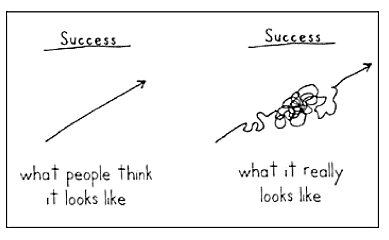
(2) Skill development is nonlinear. We believe that things build from simple to hard or from day 1 to day 2, but there is no linear development. The reality is not the straight line on the left, but the swirly line on the right.
. Credit: William Penn University Wilcox Library